
The Part of Archaeology Nobody Puts on a Poster
When people picture archaeology, they usually picture the moment of discovery: a coin glinting in the dirt, a skeleton emerging from clay, a pot being lifted free with gloved hands. I understand why. Those moments are genuinely thrilling, and I have felt my heart jump more than once at a trowel scraping across something unexpected. But if you spend enough time on a dig, you start to realize that the most important tool in anyone’s kit is not the trowel at all. It is the clipboard.
I want to spend this week’s post talking about context sheets, because they are the quiet workhorses of every excavation I have ever been part of, and almost nobody outside the field knows they exist.
What a Context Sheet Actually Is
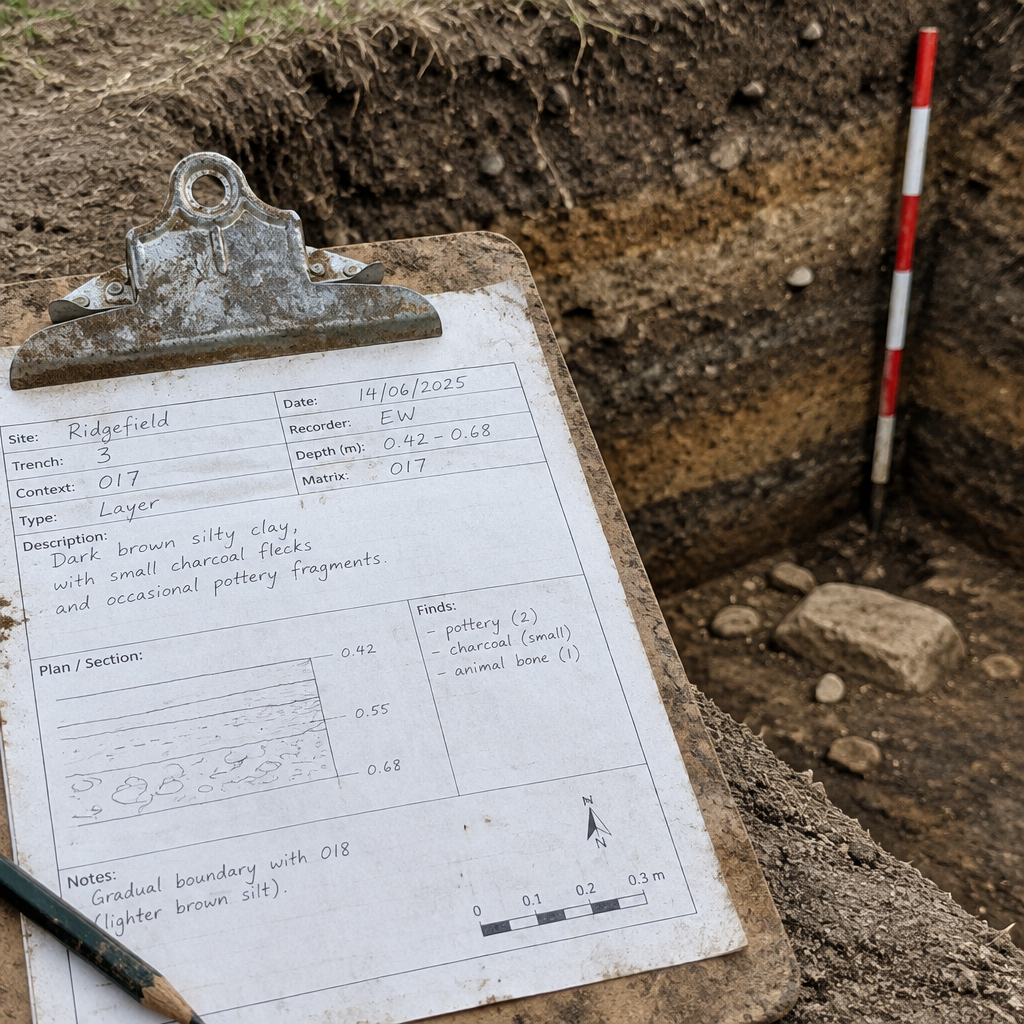
In archaeology, a ‘context’ is any single, distinct layer or feature we encounter in the ground: a patch of ash from a hearth, the fill of a pit, the surface of a floor, the cut of a ditch. Each context gets its own number, and each context gets its own sheet of paper (or, increasingly, a digital form) where we record everything we can observe about it before we remove it.
That sounds simple, but the list of things we record is long. We note the soil color, usually against a standardized color chart so that ‘brown’ means the same thing to every excavator on site. We note texture, compaction, inclusions like charcoal flecks or small stones, and how the context relates to the ones above, below, and beside it. We sketch it. We photograph it with a scale bar and a north arrow. We write a short interpretation of what we think it might be, while being careful to flag that interpretation as provisional.
It takes time. On a slow day, filling out a single context sheet properly might take twenty or thirty minutes, which can feel agonizing when you are itching to keep digging downward. But here is the uncomfortable truth every archaeologist eventually accepts: excavation is destruction. Once you remove a layer of soil, it is gone forever. The context sheet is the only thing standing between ‘we knew this’ and ‘we will never know this again.’
Why This Matters More Than the Objects
I sometimes tell visitors to our site that an artifact without context is just a pretty thing. A beautiful bead found loose in a backfill pile tells you almost nothing about how people lived. The same bead, recorded as coming from a specific layer inside a hearth, next to charred seeds and animal bone, suddenly tells a story about a meal, a fire, maybe a ritual, maybe just an ordinary evening thousands of years ago.
The context sheet is what preserves that relationship. Long after the trench has been backfilled and the team has gone home, the sheet is what lets a researcher years later reconstruct the sequence of events: what came first, what was built on top of what, what was deliberately placed versus what simply fell and got buried.
This is also why we are so stubborn about consistency. Every excavator on a site has slightly different handwriting and slightly different instincts about where one layer ends and another begins. Training people to fill out these sheets the same way, using the same vocabulary, is not bureaucratic fussiness. It is what allows a report written five years from now to actually make sense of a trench that no longer physically exists.
A Typical Afternoon With the Forms
Let me walk you through what this looks like in practice, because I think the rhythm of it is oddly satisfying once you get used to it.
- Observe first, dig later. Before anyone touches a new layer with a trowel, we stop and look. What color is it? Does it look uniform or mixed? Are there visible edges where it meets something different?
- Record before you remove. We fill in the sheet, take photographs, and draw a plan or section drawing, all before a single bucket of soil leaves that layer.
- Cross-reference constantly. Every sheet links to a master site matrix, a kind of family tree showing which contexts sit above, below, or cut into others.
- Double-check the boring details. Date, trench number, excavator’s initials, weather conditions. It feels tedious until the day you need to track down exactly who dug a layer and under what conditions, and you are grateful someone wrote it down.
On a good day, this paperwork becomes almost meditative. There is a particular pleasure in watching a stack of context sheets grow alongside a trench, knowing that the two are really telling the same story in different forms.
The Digital Shift, and What Stays the Same
Many projects now use tablets or laptops in the field instead of paper, with dropdown menus and required fields that prevent you from skipping a step. I have mixed feelings about this. The digital systems are faster and reduce the chance of illegible handwriting ruining a future researcher’s day. But there is something about the physical act of writing by hand, out in the open air, next to the very soil you are describing, that I still find grounding. Whichever format a project uses, the underlying discipline is identical: observe carefully, record honestly, and resist the temptation to interpret before you have finished describing.

Why I Wanted to Write About This
It would be easy for a project like this one to only ever celebrate the dramatic finds, the burials and hoards and inscriptions that make headlines. But most of archaeology’s real labor looks like this instead: careful, repetitive, unglamorous documentation that rarely gets photographed for a magazine. I wanted to give it a little spotlight this week, because every artifact you will ever read about in a museum label owes its meaning to someone, somewhere, filling out a form exactly like the ones I have described.
Next time you see a photo of an exciting discovery, I hope you will also picture the clipboard sitting just out of frame, and the person patiently writing down everything the dirt was willing to tell them.